Austin Dog Laws: Leash, License, Rabies and Barking Rules
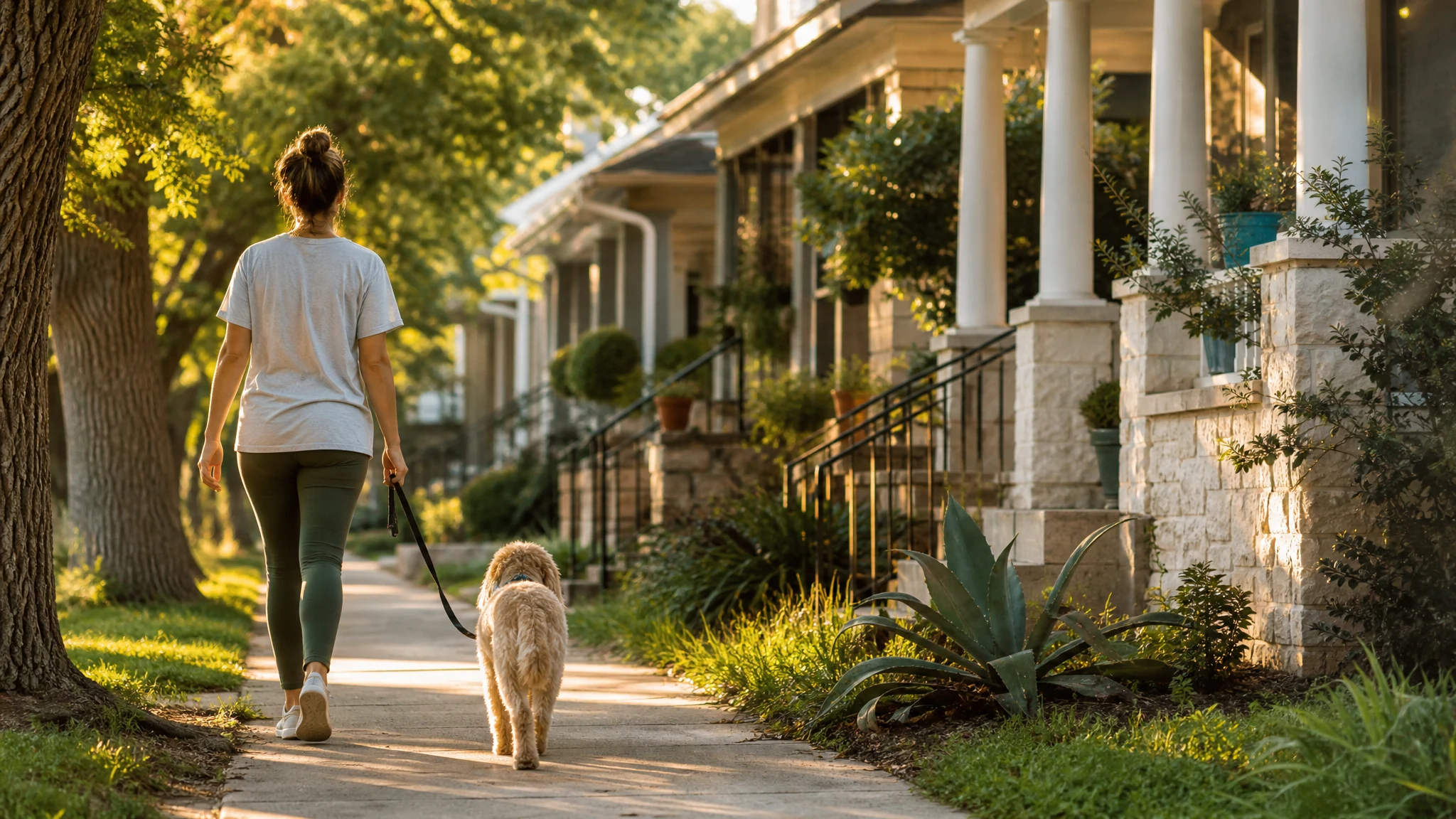
General training information. For aggression, sudden behavior changes or health concerns, see your veterinarian first.
Living with a dog in Austin means knowing a few rules and training your dog to fit them. This guide covers Austin dog laws one at a time: the leash rule, the license question, rabies vaccination, barking, dangerous dog registration and pet limits. For each one, you get a step you can take with your dog.
Some details are not published in a form we could confirm. Where that is the case, we say so and point you to the city. Laws change, so treat this as a starting point and check with the city before you act on anything.
What You Need Before You Start
- A flat buckle collar or a front-clip harness, plus a standard leash. Austin Animal Services does not publish a leash length rule that we could find, so ask the city if you want to be sure.
- Small, soft treats your dog loves, cut to pea size.
- A treat pouch or pocket you can reach quickly.
- Waste bags for every outing.
- Your dog's current rabies vaccination record.
- Fresh water for hot days.
- About ten minutes a day for short practice sessions.
Step 1: Learn the Austin Leash Law
The Austin leash law comes from Austin City Code section 3-4-1. As quoted by the Austin Chronicle, it requires an owner or handler to keep a dog under restraint. The exceptions are the public areas listed in section 3-4-4. City of Austin Parks and Recreation says dogs must be leashed in public areas unless the area is designated off-leash.
In plain terms, assume your dog needs a leash anywhere in public unless the area is clearly marked as off-leash. The sources we reviewed do not state a leash length. Some websites claim a specific length, but we could not confirm that against the code. If length matters to you, ask the city.
The City of Austin also prohibits tethering dogs within city limits by ordinance. Tying a dog to a post, tree or fence in the yard or outside a store is not a safe workaround. Use a fenced yard, a house line you hold, or bring your dog inside.
What this means for training: a leash law only works if your dog is pleasant to walk with. That makes loose-leash walking your first skill.
Step 2: Teach Loose-Leash Walking
- Start indoors. Stand still with your dog beside you. Give a treat each time the leash hangs in a loose "J" shape.
- Add one step. Walk one step, then treat beside your leg if the leash stays loose. Build up to several steps slowly.
- Stop when the leash tightens. Stand still and wait. When your dog turns back toward you or the leash loosens, say "yes" and treat.
- Move to the driveway or yard. Add mild distractions only after your dog succeeds indoors.
- Take it to the sidewalk. Keep sessions short at first. Quiet streets come before busy ones.
Reward-based methods are the approach recommended by the American Veterinary Society of Animal Behavior (AVSAB). Corrections that cause pain or fear can make a dog more anxious. That is not what you want around people and other dogs.
Step 3: Find the Austin Dog License Answer
Many owners ask about an Austin dog license. We could not find an official page that states either way whether the city requires a dog license, so we will not tell you that it does or does not. Check with Austin Animal Services before assuming. They can also tell you about any fees or tags.
Whatever the answer, it is smart to keep a collar on your dog with an ID tag showing your phone number. Pair that with a microchip registered to your current contact information. Lost dogs get home faster when they are easy to identify.
What this means for training: teach your dog to accept handling around the neck and collar. Touch the collar, give a treat, and repeat until your dog stays relaxed.
Step 4: Keep Rabies Vaccination Current
The Texas Health and Safety Code, chapter 826, requires dogs to be vaccinated against rabies by 4 months of age. Boosters follow at intervals set by state rule. City of Austin Parks and Recreation also lists rabies vaccination as a requirement for off-leash areas. Austin Animal Protection serves as the rabies control authority for the City and unincorporated Travis County.
Ask your veterinarian for the booster schedule that applies to your dog, and keep the paperwork where you can find it. Your vet is also the right person to ask about puppy vaccines before group classes. We did not find an official Austin requirement for puppy class vaccines, so ask your vet and the class provider.
What this means for training: a calm vet visit is a trainable skill. Visit the clinic for treats and a greeting without an exam, and teach your dog to stand and be touched.
Step 5: Practice a Reliable Recall for Off-Leash Areas
Austin has places where dogs can be off leash. The City of Austin lists these general rules for off-leash areas: leash your dog to and from the area, keep your dog within sight and sound control, do not bring dogs in heat, show proof of rabies vaccination if asked, and clean up waste. Parks generally open from 5 a.m. to 10 p.m. unless posted otherwise.
Places that the city or the Austin Parks Foundation list as off-leash include:
- Onion Creek Greenbelt, 6800 Onion Creek Drive
- Mary Moore Searight Metro Park off-leash trail, 9500 S 1st St., listed by the city as a 1.22 mile shared use trail
- Emma Long Metro Park Turkey Creek Trail, 2100 City Park Rd., listed as a 1.92 mile shared use trail. The park's own page says pets must stay on leash, so confirm the posted rules on site.
- Walnut Creek Metropolitan Park, 12138 N Lamar Blvd
- Red Bud Isle, 3401 Red Bud Trl.
- Auditorium Shores at Town Lake
We could not confirm area-specific rules for every park, so check the signs and the city's park pages before you go.
"Within sight and sound control" is a training goal, not just a legal phrase. If your dog will not come when called, off-leash time is a risk for everyone.
- Pick a recall word. Use one cue, such as "here," and never use it for anything unpleasant.
- Pay big. Say the cue in a happy voice and give several treats in a row when your dog arrives.
- Practice indoors first. Call from one room to another, then across the yard.
- Use a long line outdoors. Keep your dog attached while you build reliability. Keep the line free of tangles and your hands protected.
- Add distractions slowly. Work up from a quiet yard to a park edge, and only trust off-leash recall once it holds up with real distractions.
- Leash up on the way in and out. This is a city rule for off-leash areas and a good habit.
Step 6: Understand Barking and Noise Rules
Austin City Code addresses noisy animals in section 3-2-2, as reported by the Austin Chronicle. That report comes from a secondary source, and we could not confirm the exact wording of the rule. Because of that, we will not paraphrase what counts as a violation. Ask Austin Animal Services or the city for the current text if a neighbor raises a complaint.
What you can do is work on the cause. Dogs bark when they are bored, scared, under-exercised or alerting to sights and sounds. Barking can also reflect separation distress, which is a behavior concern rather than a manners problem.
- Give a daily walk and a few minutes of sniffing, chewing or food puzzles.
- Block the view of the street if your dog barks at passersby.
- Teach "quiet" by rewarding the pause after a bark.
- Reward calm behavior before barking starts.
- Keep your dog inside when you are away if barking tends to carry.
If barking comes with panic, destruction or drooling when you leave, talk to your veterinarian. A medical problem or an anxiety disorder may be involved.
Step 7: Know the Dangerous Dog Rule
A dangerous dog is a legal designation defined by the State of Texas. It applies to dogs a court has determined to be a danger to people. According to City of Austin Animal Services, the owner must register the dog as dangerous with the City of Austin and pay an annual $50 fee.
This is not a label for a dog that barks or pulls on the leash. It is a court-based designation with real consequences, so take it seriously if it applies to you. Ask Austin Animal Services about the current process.
What this means for training: if your dog has growled, lunged, snapped or bitten a person, do not try to fix it with tips from an article. See your veterinarian first to rule out pain or illness. Then work with a certified behavior professional. Management matters until you have a plan: use secure fencing, a leash in public, and distance from people.
Step 8: Check the Pet Limit
We did not find a published limit on how many dogs you can keep in Austin. Do not assume there is none, and do not guess. Before you add another dog, ask the city whether a limit applies to your address and housing type. If you rent, also read your lease and any HOA rules.
Step 9: Plan for Austin Weather and Water
Rules are not the only thing that affects your walks. City of Austin Animal Services advises that pavement can quickly burn paw pads. It recommends limiting exercise on hot days, never leaving pets in a car even with the windows down, and giving outdoor pets shade and cool water. Very old, very young and overweight dogs, dogs with heart or breathing disease, and short-muzzled breeds face higher risk.
For freezing weather, the city advises bringing pets inside, keeping walks short, checking paws for ice balls, and watching for shivering, lethargy and frostbite on ears and tails.
Water can be a hazard too. In August 2019, KUT reported that city officials told residents to keep pets out of Lady Bird Lake after dogs died and preliminary tests pointed to blue-green algae. The advice was to bathe a dog right away if it enters the water and see a vet for symptoms such as heavy drooling, vomiting or diarrhea. That was a 2019 event, and we could not confirm a current advisory, so check with the city before letting your dog swim.
If your dog shows signs of heatstroke, poisoning or any sudden illness, go to a veterinarian right away.
Tips for Success
- Practice in short bursts. Five minutes, twice a day, beats one long session.
- Walk in the early morning or after sunset in summer. Test the pavement with the back of your hand.
- Carry waste bags every time. Cleanup is part of the city's off-leash rules.
- Keep treats for the hardest skills, such as recall, extra special.
- If you want a trainer, look for credentials you can verify. The CCPDT Certified Dog Trainer Directory lets you look up certified trainers in Austin.
Common Mistakes to Avoid
- Assuming a park is off-leash. Look for signs. Even where a trail is listed as off-leash, the park may post its own rules.
- Tethering a dog outside. The city prohibits it.
- Calling your dog only to end fun. Recall gets weaker when it always means leaving.
- Scolding barking. Yelling can sound like joining in. Reward quiet instead.
- Using pain-based tools. Shock, prong and choke collars, alpha rolls and scruffing are not recommended. AVSAB advises reward-based training.
- Letting the rabies record lapse. Put the booster date on your calendar.
What Results You Can Expect
With steady practice, many dogs learn to walk more calmly on a leash within a few weeks. Recall usually takes longer, and results vary by age, breed, history and environment. Barking tends to improve when the cause is addressed, though it may not disappear completely. No method works for every dog, and we cannot promise a specific outcome.
If progress stalls, or your dog shows fear or aggression, talk to your veterinarian, who can help rule out medical causes. For aggression toward people, add a certified behavior professional to the team.
Where to Ask the City
Three items need an answer from the city: license requirements and fees, any limit on the number of pets, and the current text of the noise rule. Austin Animal Services is the place to start. Check the park pages before visiting an off-leash area, since rules and conditions can change.
If you are adding a dog to your home, Austin Animal Center, Austin Pets Alive! and Austin Humane Society are local organizations that work with dogs and adopters. Ask each one about its own policies and programs.
Sources
- City of Austin, Austin Animal Services, Animal Protection
- City of Austin Parks and Recreation, Dog Parks: Off-Leash Areas
- City of Austin Parks and Recreation, Trail Directory
- City of Austin Parks and Recreation, Onion Creek Metropolitan Park
- Austin Parks Foundation, Parks for Pups
- City of Austin Animal Services, Weather safety for pets
- Texas Health and Safety Code Sec. 826.021
- Austin Chronicle, The Common Law (quoting Austin City Code 3-4-1)
- Austin Chronicle, The Common Law (noise rule, secondary source)
- KUT public radio, August 5, 2019
- CCPDT Certified Dog Trainer Directory
- Austin Animal Center
- Austin Pets Alive!
- Austin Humane Society